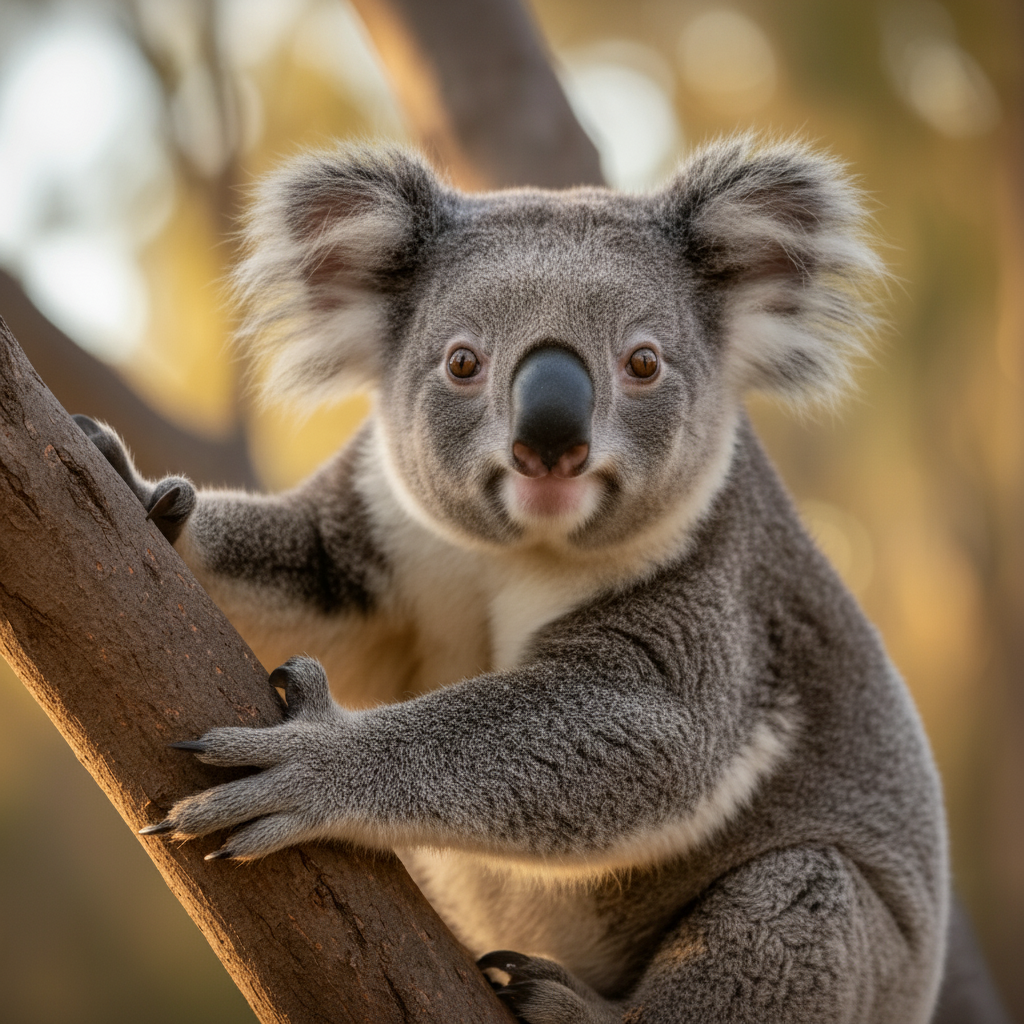
Looks like a stuffed toy. Lives like a philosopher. Secretly a chaos gremlin.
Wait — It's Not a Bear?
Meet the koala (Phascolarctos cinereus) — Australia's most huggable export and the world's most successful napper. Despite the name and the undeniable teddy-bear energy, koalas are not bears. They're marsupials, making them far more closely related to wombats and kangaroos than to anything you'd find at a picnic.
They measure 60–85 cm, sport thick grey-brown fur, gloriously fluffy ears, and a big shiny nose that looks permanently surprised. No tail — but their rump is so densely padded with fur that they've essentially evolved a built-in cushion for sitting in trees all day. Honestly, goals.
Surprise! There's More to This Fluffball
Two thumbs — because one wasn't enough Koalas evolved two opposable "thumbs" on each front paw for maximum tree-gripping power. Their hind feet have a special double-clawed toe used exclusively for grooming. They are, in short, better equipped for climbing than most of us are for anything.
Teeth with an expiry date Eucalyptus leaves are basically sandpaper with nutrients. A koala's teeth grind down continuously throughout its life, and many older wild koalas eventually lose their molars entirely. It's one of the most common causes of death in the wild — a sobering reminder that even the cutest animals have their struggles.
Their fingerprints could fool a detective Koalas are the only non-primate known to have fingerprints nearly identical to human ones — same loops, same whorls, same everything. They evolved this independently, purely for grip. Forensic investigators have reportedly been confused by koala prints at crime scenes. The koala: accidental criminal mastermind.
Smallest brain, biggest vibes Koalas have one of the smallest brain-to-body ratios of any mammal. An adult brain weighs about 19.2 grams, and 40% of the skull is just… fluid. Scientists think this is an energy-saving adaptation to their low-calorie diet. Fewer thoughts, more naps. A lifestyle philosophy we can all consider.
Bad eyes, incredible nose Koalas have poor colour vision, but their sense of smell is extraordinary. They can sniff out which leaves are toxic, which are delicious, and which trees have already been claimed by other koalas. Essentially, their nose does all the heavy lifting their eyes refuse to do.
Daily Life: A Masterclass in Doing Less
Pickiest eater at the table Out of 600+ eucalyptus species, koalas will deign to eat about 30. And not just any leaves — only the freshest, most tender ones at the very top of the tree. They are, essentially, the food critics of the animal kingdom.
Never drinks water (and proud of it) The word "koala" is thought to come from an Aboriginal word meaning "no water." Koalas get almost all their hydration from eucalyptus leaves. As a bonus, this gives their fur a natural eucalyptus scent — nature's own bug repellent. They smell like a spa. Respect.
Professional sleeper, 18–22 hours a day Eucalyptus leaves are toxic, low in calories, and hard to digest. The koala's solution? Evolve a 2-metre-long caecum to detoxify everything, slow the metabolism way down, and sleep for the better part of every day. When awake, they mostly just… sit there. Living the dream, honestly.
Tree-hugging is actually air conditioning Koalas hug trees not just because they love them (though surely they do), but because tree trunks are significantly cooler than the surrounding air on hot days. It's a full-body cooling system. They figured out passive climate control millions of years before humans did.
Going to the ground is basically a horror movie Koalas spend 98% of their lives in trees — and for good reason. On the ground, they shuffle along at a pace that can only be described as "determined but optimistic." Dogs, foxes, and cars are all genuine threats. They only come down when absolutely necessary, and even then, you can tell they're not happy about it.
Fun Facts That Will Break Your Brain
Joeys eat mum's special "pap" — yes, really When a koala joey is ready to transition from milk to eucalyptus leaves, there's a problem: the leaves are toxic and the joey has no gut bacteria to handle them. Mum's solution is to produce a special semi-digested substance called "pap" for the joey to eat, packed with the microbiome it needs. It's gross, it's brilliant, and it works. Nature is wild.
The T-Rex in Jurassic Park was a koala Male koalas have an extra set of vocal cords outside their larynx, letting them produce deep, bellowing roars audible for kilometres — about 20 times deeper than their body size should allow. The sound designers for Jurassic Park recorded male koalas and processed the audio for the T-Rex. The most terrifying dinosaur in cinema history sounded like a very grumpy eucalyptus enthusiast.
How Long Do Koalas Live?
Wild koalas typically live 10–15 years. In captivity — with no predators, reliable food, and actual veterinary care — they can reach 15–20 years, with some overachievers hitting 21. The record holder at Lone Pine Koala Sanctuary in Australia was a female named Gidji, who made it to 21 and presumably spent most of it asleep.
- Wild males: ~10–12 years. They're territorial, fight over mates, roam further, and take more risks. Classic.
- Wild females: ~12–15 years, occasionally up to 17. Statistically wiser.
- Captive koalas: Living their best, longest lives.
Bonus fact: a female koala's actual breeding window is surprisingly short. Despite living over a decade, fertility drops sharply after age 10 — meaning most successful reproduction happens between ages 3–8. Quality over quantity, apparently.
Obsessed with koalas now? Same. Wear the love with the Heart in Pawz: Koala Graphic T-Shirt.