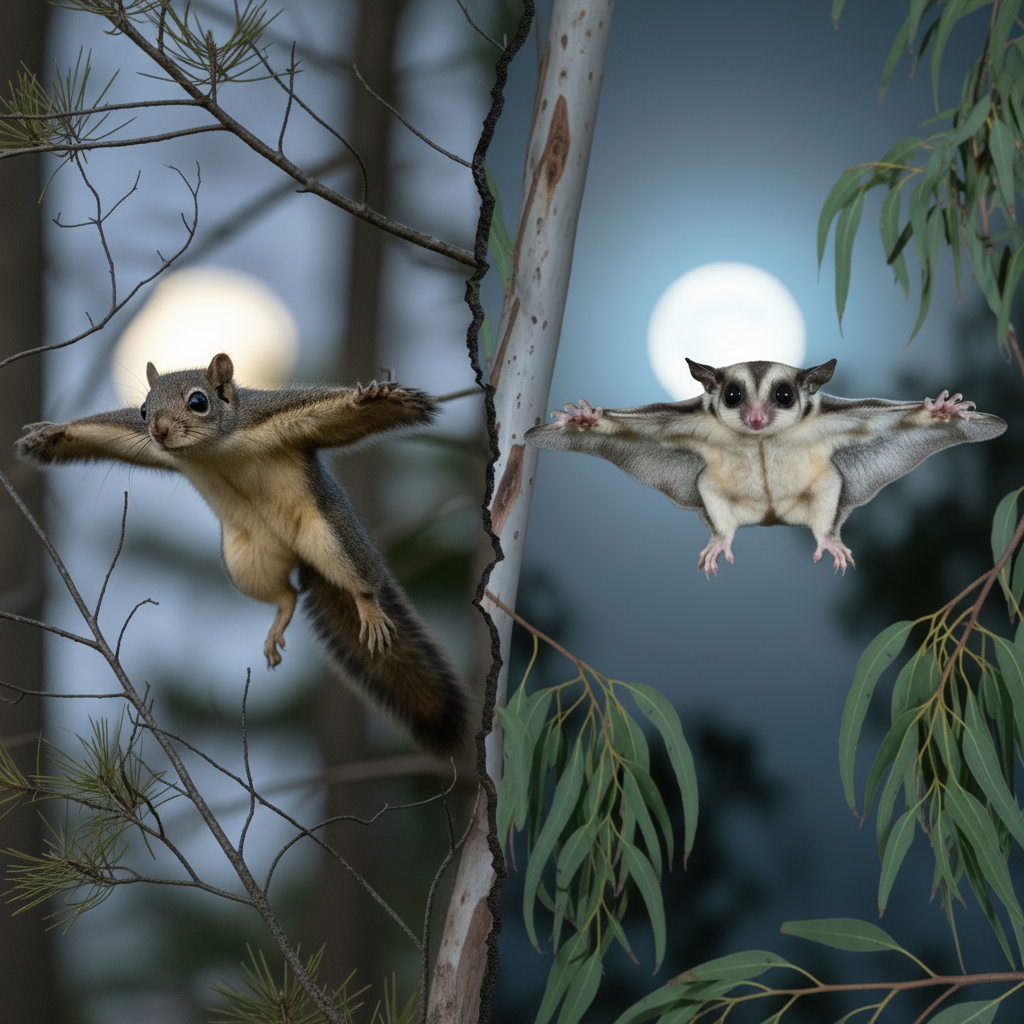
If you've ever seen a sugar glider and thought "Oh wow, a flying squirrel from Australia!" — you're not alone. These two critters look like they were separated at birth, but spoiler alert: one's a rodent, the other's a marsupial. They're basically the "same outfit, different designer" situation of the animal kingdom.
Scientists call this convergent evolution — which is just a fancy way of saying nature copy-pasted the gliding idea twice, from completely different blueprints. Flying squirrels are closer to chipmunks and rats. Sugar gliders are closer to kangaroos and possums. One is a caped crusader of the temperate forest; the other is a tiny pouched party animal from the eucalyptus belt. Same vibe. Zero shared ancestry.
🌙 Nightlife of the Gliders
Flying squirrels: The introverts of the treetops. They sneak out at dusk, glide silently through the dark like tiny stealth bombers, stash nuts like they're prepping for the apocalypse, and go home alone. Peak activity hits around midnight. By 4 AM they're back in their tree cavity, unbothered and unapologetic.
Sugar gliders: The extroverts. They wake up, immediately start grooming each other, chirp, bark, hiss, and then glide off together for a nectar party. Think frat house meets forest canopy — with a strict 6 PM start time and cuddle piles at 2 AM. Their nights are basically one long group hangout with snacks.
🍽️ Dining Habits
Flying squirrels: Nuts, seeds, fungi, insects, and the occasional bird egg — basically the forest buffet. Bonus: they spread fungal spores underground, making them the unsung gardeners of the woods. No flying squirrel, no healthy forest. Respect.
Sugar gliders: Sweet tooth central. Sap, nectar, fruits, plus the occasional insect for protein. They'll gouge eucalyptus bark like tiny lumberjacks just to get to the good stuff. In captivity, they'll happily switch to fruit smoothies and nectar substitutes — the original meal-prep crowd.
🧪 Weird But True
- 🌈 Flying squirrels glow neon pink under UV light. Yes, really. Scientists aren't entirely sure why. We like to think they're just built for the rave.
- 🏷️ Sugar gliders mark their humans with scent glands on their heads and chests. If your sugar glider rubs its face on you, congratulations — you are now officially their property.
- ✈️ Flying squirrels can pull off sharp 90° mid-air turns using their flat tails as rudders and brakes. Sugar gliders? Smoother operators — long tails for balance, gliding up to 165 feet like tiny sky surfers.
- 🎙️ Sugar gliders can recognize individual human voices and respond differently to familiar vs. unfamiliar tones. They know who you are. They're judging you accordingly.
- 🌲 Giant flying squirrels in Asia can grow up to 3 feet long and weigh nearly 10 pounds. The North American ones are pocket-sized. The Asian ones are a whole different conversation.
- 💤 Sugar gliders form "glider balls" — piling 6 or 7 together in a nest hollow for warmth and bonding.
- ❄️ Flying squirrels share nests in winter despite being mostly solitary — a rare moment of togetherness driven purely by the need to not freeze. Relatable.
🏡 Wild vs. Captive Life
Flying squirrels in captivity: Still shy, still nocturnal, still plotting nut heists. They'll tolerate you, recognize your face, and occasionally not bite you. Don't expect cuddles — expect respectful coexistence. Lifespan: up to 10 years with good care.
Sugar gliders in captivity: Social butterflies. They bond deeply with humans, ride around in shirt pockets, demand group hugs, and will literally sleep on you if given the chance. Keep one alone and it gets depressed — like a teenager without Wi-Fi. Lifespan: up to 14 years in captivity, making them a long-term commitment and a long-term best friend.
🎭 The Big Picture
| Flying Squirrel 🐿️ | Sugar Glider 🪶 | |
|---|---|---|
| Family | Rodent (Sciuridae) | Marsupial (Petauridae) |
| Home turf | North America, Europe, Asia | Australia, Indonesia, New Guinea |
| Social vibe | Lone wolf | Pack animal |
| Superpower | Neon UV glow | Voice recognition + scent marking |
| Ecosystem role | Fungal spore engineer | Pollinator & insect controller |
| Captivity style | Tolerates you | Obsessed with you |
| Lifespan (captive) | Up to 10 years | Up to 14 years |
Flying squirrels are the forest engineers, spreading fungi and keeping ecosystems quietly healthy. Sugar gliders are the pollinators and party animals, keeping eucalyptus forests buzzing with life. Both evolved gliding membranes completely independently — proving that nature sometimes says: "Copy the homework, but change a few answers."
Two animals. One incredible trick. Zero family resemblance. All the charm. 🐾